
More than a pretty room
Finding somewhere to stay is easy. Finding a place where arriving feels good, you can sleep properly and your morning does not start with a long commute takes a little more thought. The prettiest photo and the lowest nightly rate will not, on their own, tell you which place is right for you.
For a city break, I would start with the neighbourhood rather than the room. Choose an area first, then take a proper look at three genuinely comparable places. That way you are not jumping between fifty listings, and you are less likely to overlook an important detail.
What makes a good place to stay for you?
Write a short list of your must-haves. A private bathroom? Twin beds? A lift? Late check-in? A quiet room? Parking? Anything you need to feel comfortable belongs here. A pool, distinctive interiors or a balcony with a view can be lovely extras, but compare those only once the essentials are covered.
Who you travel with matters. A room that is comfortable for one person may feel different with two large suitcases. With children, check the actual sleeping arrangements; with an older travel companion, consider the stairs. A “triple room” may have three proper beds, or a sofa bed. Start with the description of your particular room, not the property’s general photo gallery.
Choose the neighbourhood around your plans
Mark four or five places you definitely want to visit on a map. Then look for an area with straightforward journeys to them. You do not necessarily need to stay on the main square: a good tram or metro connection can be more useful than a “central location” label.
Check the route to at least three places: the airport or station, your first day’s main activity and an area where you would enjoy having dinner. Count the changes, the walk to the stop and the service’s operating hours. Two points that look close on a map may be separated by a river, a steep hill or a major road that is difficult to cross.
If a listing says “ten minutes from the centre”, find out whether that means on foot or by car, and which part of the centre it refers to. The exact address is one of the most useful pieces of information. With an apartment, key collection may be somewhere else: check that separately.
Is staying further out really cheaper?
Take an imaginary example for two people staying three nights. The place further out costs €75 a night; the better-located option costs €95. That is a €60 difference in total. If staying further out adds €36 in transport costs, your real saving is €24. If it also means an extra hour travelling each day, you need to decide whether that is worth it.
You may still need a travel pass when staying centrally, of course. Count only the genuine extra cost, rather than adding the same ticket twice. The right choice is not automatically the more expensive hotel: a quiet, comfortable place outside the centre with a direct transport connection can be excellent. The aim is to see the whole picture.
Read the reviews, not just the score
A high score alone is not enough. Look at how many reviews it is based on, how recent they are and who wrote them. Couples, families and solo travellers value different things. The season matters too: a winter review may tell you very little about summer heat.
Look for recurring patterns. One complaint about a noisy guest is different from several recent comments about the bar outside or poorly insulated windows. Cleanliness, mattresses, hot water, air conditioning, wifi and staff availability are all worth watching for.
Read the middle-of-the-road reviews as well: they often contain the most useful details. Somewhere between “wonderful” and “never again”, you may find the sentence that matters to your decision, such as the lift starting on the first floor or courtyard-facing rooms being quieter.
If reviews mention renovation work, check the dates and ask the property. An old problem does not automatically describe the situation today, but I would take recent comments from several guests seriously.
Photos: look for the room you are actually booking
The suite in the main photo is not necessarily the room offered at the lowest price. Open the photos and amenities for your selected room type. Check the beds, window, bathroom, room size and any balcony.
“Private bathroom” and “en-suite bathroom” can mean different things: you may have a bathroom for your exclusive use that opens off the corridor. If that matters, ask. Likewise, “city view” does not necessarily mean a panorama, and an “air-conditioned property” is no substitute for checking your room’s own amenities.
Guest photos can help too, but keep their dates and room types in mind. A different wing or a picture taken before refurbishment can be misleading.
What is included in the final price?
Compare the same dates, number of guests, room type and cancellation conditions. Check whether breakfast, cleaning fees, mandatory service charges and any local tax are included. Add anything payable at the property to your own budget too.
Treat the security deposit separately. It may be refundable or simply a hold on your card, so it is not necessarily a final expense, but you still need funds available. Ask about the amount, payment method and release conditions. Your bank may take longer to show the release than the property takes to process it.
Breakfast is about more than price. If you leave early for a day trip, you may miss it. In an apartment, check the kitchen equipment: a kitchenette does not automatically include an oven or everything needed to cook a full dinner.
Check-in: arrange a late arrival in advance
Check when check-in opens and closes. A 24-hour reception, self check-in and late arrival by arrangement are three different things. The last may require advance notice or an additional fee.
For self check-in, make sure you have the address, details identifying the entrance and apartment, instructions for the key safe or access code and a working contact number before you leave. Do not share access codes publicly. Ask how late someone will be available to help if you are delayed.
Arriving early does not automatically mean early access to your room. If you arrive in the morning, luggage storage may be the practical answer. Check the same for departure day if you are not travelling home until the evening.
Arriving by car? “Parking available” is not a reserved space
Ask whether this means the property’s own parking, a nearby public garage or street parking. Can you book ahead, is a space guaranteed, and is the quoted rate per calendar day, per night or per 24 hours? Leaving and returning several times may have separate conditions.
In an underground garage, the height limit matters, especially with a roof box. In a narrow historic centre, ask about the approach route and any restricted zones too. A hotel reservation does not necessarily include permission to drive into the area.
If parking is elsewhere, check the walk with luggage and how you can get back to your car at night. CCTV, enclosed parking and staffed security do not mean the same thing. Choose based on the operator’s description of the actual service.
Cancellation and payment: the date matters as much as the label
Free cancellation usually has a deadline. Save the exact date, time and time zone, and set yourself an earlier reminder. Check when your card will be charged, what happens if you do not turn up and whether changing the booking can change the price.
A non-refundable rate makes sense when you consciously accept the risk in return for the saving. Accommodation booked for specific dates does not generally come with the usual 14-day cooling-off right for online purchases; see the EU consumer guidance. Read the booking’s own conditions before paying.
What should you ask the property?
A short, specific question is more likely to get a useful answer. For example: “We are considering a twin room for two people for three nights. We expect to arrive at around 11 pm. Can we check in then without an extra charge? Does this room type have a private en-suite bathroom? Can we reserve a parking space, and what would parking cost for the whole stay?”
Keep the reply with your booking. For an especially important requirement, do not rely only on a general property description: make sure the answer applies to your room and your arrival.
A final checklist
- Are the exact address and selected room type right for you?
- Have you checked the bathroom, beds, lift and air conditioning?
- Will check-in work at your actual arrival time?
- Does the total include every mandatory charge, or have you noted the extras?
- Are the cancellation deadline and payment date clear?
- Do you know what kind of parking is offered and whether you can reserve it?
- Have you read recent reviews covering what matters to you?
- Do you have the confirmation and contact details available offline?
The right place to stay is not necessarily the most expensive or the most central. It is the one that suits the rhythm of your trip and lets you know what to expect. A lovely room is a good start. A smooth arrival, a restful night’s sleep and easy journeys are what make it truly worthwhile.
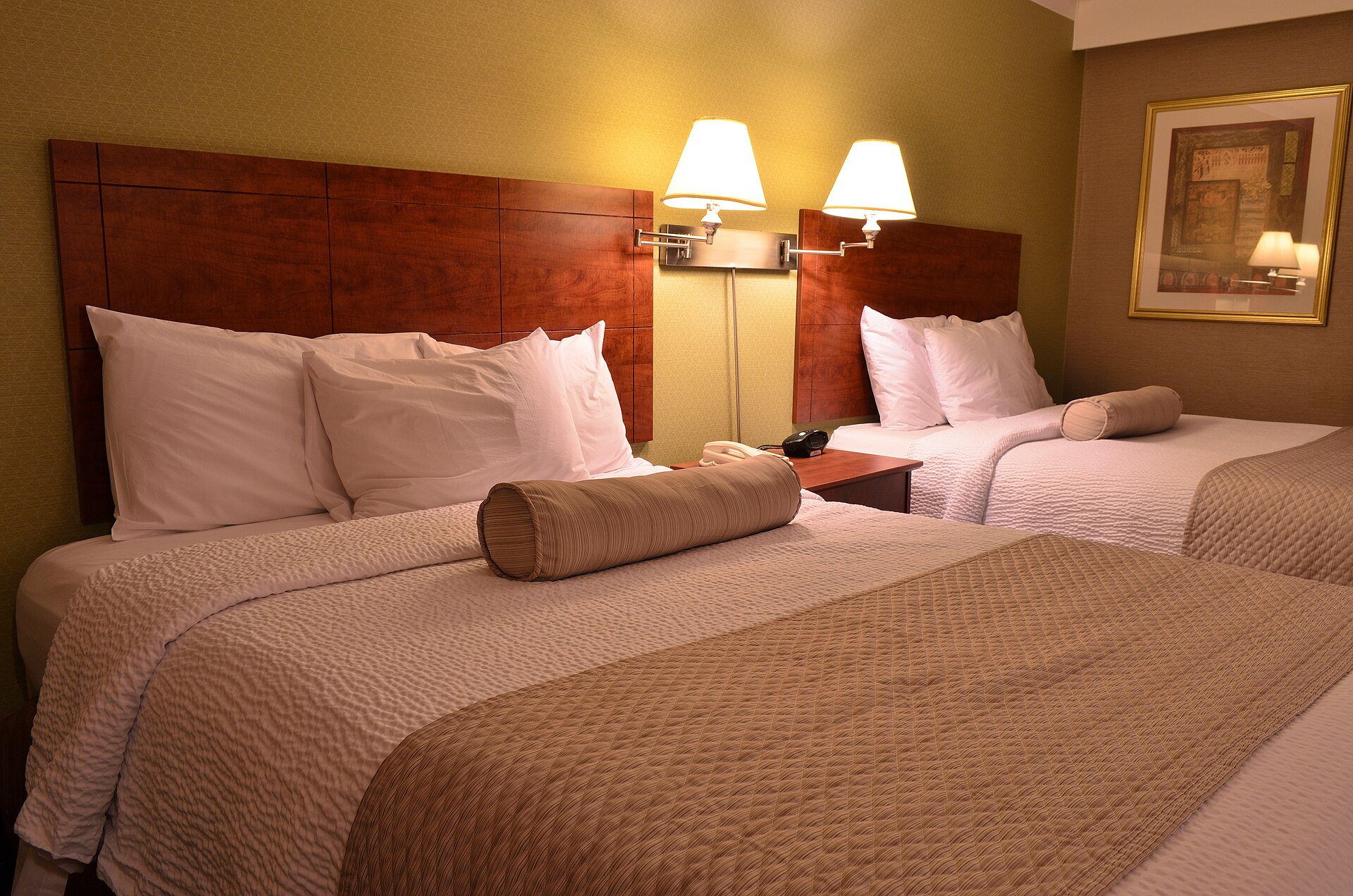
Cover image: hotel room, for illustration; not a specific accommodation recommendation. Photo: Open Grid Scheduler / Grid Engine, Wikimedia Commons, CC0 1.0. The cover may be cropped for display. Sources checked: November 2026.
