
The ticket price is only the beginning
You find a wonderfully cheap flight, feel pleased with yourself, and somehow reach the end of the booking with a much higher total in your basket. Sound familiar? It does not necessarily mean the offer was bad. It means the first price you saw was not yet the price of your trip.
I like to choose flights so that the whole journey makes sense, rather than simply finding the lowest fare. In this guide, we will look at comparing two offers, checking baggage, spotting risky connections and keeping the right information in front of you before paying. The figures below are illustrative calculations, not current bookable offers.
First, decide what kind of trip you want
Before opening twenty browser tabs, write down four things: which days you can travel, how many full days you want at your destination, what luggage you need and your overall travel budget. “Friday to Monday” is not enough on its own: a late Friday arrival and an early Monday departure can easily leave you with just two usable days.
Separate your essentials from your preferences. If you have to work on Monday, returning on Sunday is fixed. If you can travel on several weekends, comparing dates may be more useful than repeatedly checking the price of one particular flight. First filter for times that actually work for you, then rank them by price.
Compare the total cost on a like-for-like basis
Flight + necessary baggage + extras you actually want + airport transport + any additional costs caused by the flight times. Use this as the basis for your calculation. Comparing one offer with a small backpack and another with a checked suitcase is misleading.
In an imaginary example, Flight A costs €70 return. The luggage you need costs €40, return transport from the arrival airport costs €32, and arriving late adds a €25 accommodation surcharge. That brings the total to €167. Flight B costs €115, includes the same luggage, has €18 airport transport and gets you there in time for normal check-in. Its total is €133. In this example, the higher basic fare leaves you €34 better off.
When travelling with others, distinguish per-person costs from shared costs. Two flight tickets cost twice as much as one, but a shared hotel room or taxi does not automatically do so. One shared checked bag might be enough, but decide that around what you actually need to pack.
Baggage: not all cabin luggage is the same
A small under-seat bag, a cabin suitcase for the overhead locker and checked luggage are different things. Do not rely on a suitcase icon on the booking page: read the number of bags, dimensions, weight limit and which flight legs the allowance covers.
Measure your own bag when packed, including any protruding parts. Follow the airline’s rules on wheels and handles. “They let me take it last time” is less reliable than having a bag that meets the dimensions. If you fly with different airlines, check the rules in both directions: luggage included on one flight may cost extra on the other.
Also check whether a higher fare bundle genuinely costs less than adding only the baggage you need. If seat selection and flexible changes do not matter to you, a bundle of extra services may not be worthwhile. If you need them, however, buying each item separately could cost more.
An airport name is not the same as a city centre
Always check the three-letter airport code. A large city may be served by several airports, with very different distances and transport options. Your aim is to reach your accommodation, not merely the airport.
When planning the transfer, find the arrival terminal, scheduled landing time, last usable bus or train, ticket price and final stop. You may still have another journey from the city-centre terminus. Landing time does not mean you will be standing at the bus stop that minute: getting off the aircraft, any border checks and baggage collection all take time.
If catching the last cheap service depends on everything running perfectly on time, calculate the alternative too. The offer may still work, but it is better to know before booking. For the return journey, check whether public transport can get you to the airport for an early departure.
Your time has value too
A cheap flight is particularly useful when it gives you usable time in the city. Write down when you expect to reach your accommodation and when you will need to leave it again. These times tell you more about the trip than the flight duration alone.
Think about the day after you return as well. Going straight to work after a night-time arrival is very different from coming home to a day off. You do not have to pay extra for every comfort, but choose your compromises consciously.
Connections: one booking or a self-transfer?
Pay particular attention to the term “self-transfer”. The two legs may be separate tickets, you may have to collect and recheck your luggage, change terminals or go through security again. An itinerary displayed as a single search result is not necessarily a protected connection.
What happens if your first flight is delayed and you miss the next one can differ between connecting flights on one booking and separately purchased tickets. Whether EU rules apply also depends on the route and operating airline; the official EU air passenger rights guide explains the conditions.
For a self-transfer, ask not only whether the planned connection time is enough, but also what you will do if it is not. Is there a later flight that day? Who pays for a new ticket or hotel? What exactly does an intermediary’s connection guarantee cover, and how quickly must you report a problem? If you cannot answer these clearly, a direct flight may be a much more relaxed choice for a short city break.
Where should you book?
A comparison site is a useful starting point: it gives you a quick overview of dates and options. Before paying, check the same flight on the airline’s own website, for the same number of travellers and the same luggage. Do not compare a search-result price with a fully configured basket.
When booking through an intermediary, check who handles changes, how to contact customer support, what administration fees may apply and whether you receive the airline’s booking reference. Booking directly does not automatically make a ticket flexible either: your chosen fare conditions still apply. Weigh the ease of dealing with changes alongside a saving of a few euros.
What does a “flexible” ticket actually allow?
Changing a booking, getting a refund and correcting a name are separate matters. Even when a change fee is waived, you may still need to pay the difference between the old and new fares. A refund may be paid in money or a voucher; always read the specific conditions.
Do not assume you can return a flight ticket bought online within fourteen days without giving a reason. The general cooling-off rule for online purchases does not apply to flight tickets. The EU consumer guide lists the exceptions. This is a different issue from an airline cancelling or changing your flight.
Take two minutes to check before paying
- Does the name match your travel document and the airline’s name-entry instructions?
- Are the dates, year, airport codes and every flight leg correct?
- Is the luggage you need included in both directions?
- Are you looking at the final total for everyone travelling, in the correct currency?
- Have any unwanted extras been selected?
- Do accommodation check-in and airport transport work with the flight times?
- Do you understand the change and cancellation conditions?
- Have you entered your own working email address and phone number?
A few important steps after booking
Save the confirmation, booking reference, purchased services and fare conditions. A charge appearing on your bank account does not replace confirmation of a successful booking. If you are unsure whether payment went through, check the booking status before immediately buying another ticket.
Add the opening time and deadline for online check-in to your calendar, and check which boarding-pass formats the airline accepts at that airport. Check-in, bag drop and gate closure may have separate deadlines. Always use the airline’s and airport’s current information.
Check the schedule again before departure, and download the documents you need so they are available offline. The aim is not to over-plan every detail: it is to make the decisions that would be much less pleasant on a rushed morning.
For me, a good deal is one whose full cost you understand, which gives you useful time at your destination and comes with conditions you can accept. Once those things work, the basic fare becomes a genuinely useful comparison.
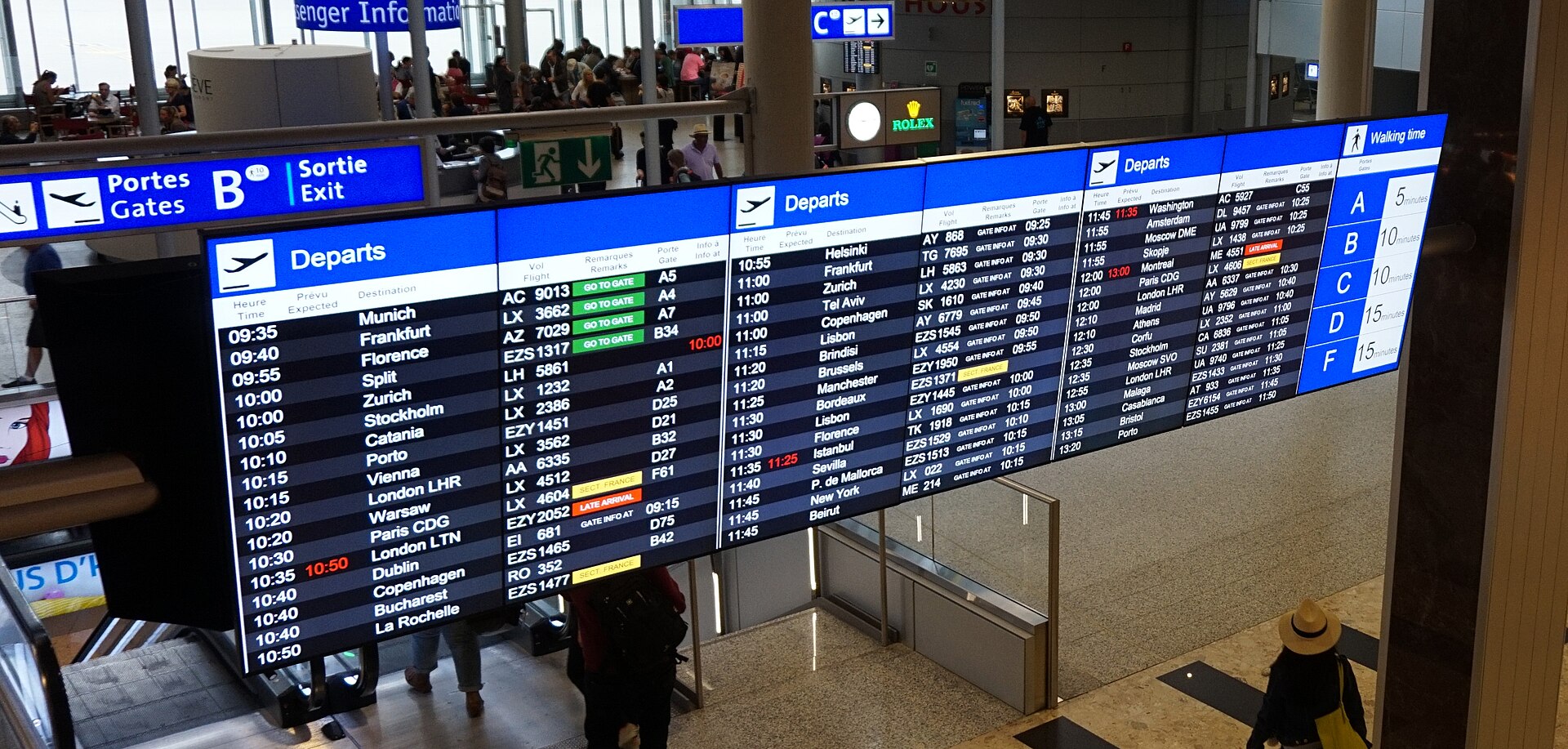
Cover image: departure board at Geneva Airport. Photo: Tiia Monto / Wikimedia Commons, CC BY-SA 3.0. The cover may be cropped for display. Sources checked for the original article: November 2026.
